Showing posts with label community life. Show all posts

Friday, 12 September 2025

In Memoriam: Calvin Seerveld by Rebekah Smick
In Memoriam: Calvin Seerveld
 

In Memoriam: Calvin Seerveld

by Rebekah Smick
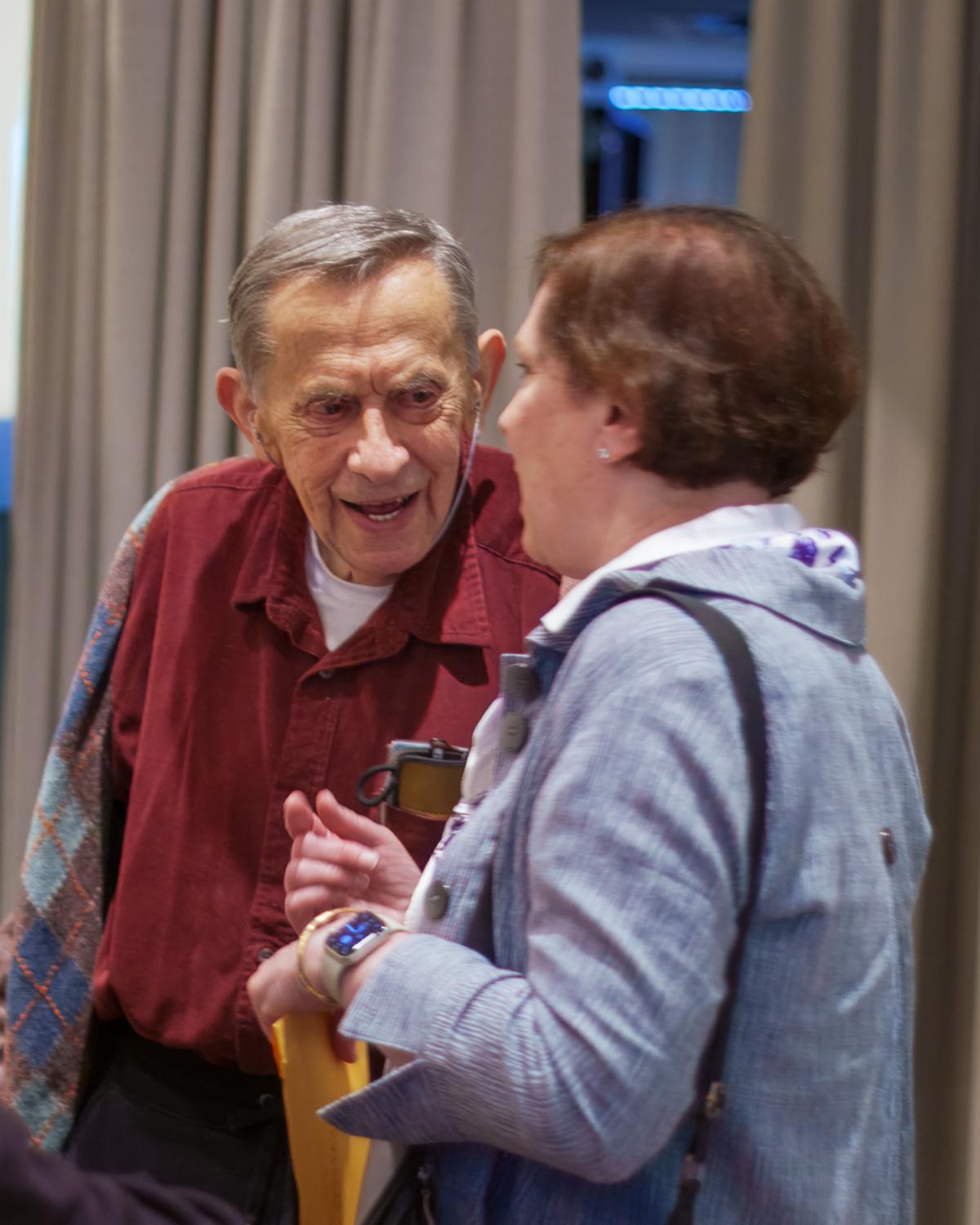
 

On August 5, 2025, I received the unwelcome news from Peter Enneson, another one-time student and long-time associate of Calvin Seerveld, that Cal had passed on from this life very much at peace just a few days shy of his 95th birthday. As Cal had just received the proofs for a fourth volume of his Tough Stuff from the Bible: Tendered Gently, a newly published collection of his meditations on scripture, I knew that that peace was born not only of his readiness to be at home with his Lord, but of his strong desire to bring to fruition several projects he had been pursuing over the last years, especially since the death of his beloved wife Inès in 2021. He had been steadily working, despite declining health and several stays in hospital, on donating his art collection to Trinity Christian College in Chicago, and his library to Redeemer University in Ancaster, Ontario, and on preparing the final manuscripts for the publication of his collected meditations on scripture. As Peter and others who were closely involved with those projects know, Cal was very upfront about his hope to be able to complete them before, in his words, “final earth issues” prevented him from doing so. How heartened we all are that he was able to bring them to completion and how blessed that his legacy as one of the most vibrant voices in reformational Christian thought has been increased in these ways in these last months and days.


Like so much of Cal’s orientation to his work as a professor of aesthetic theory at the Institute for Christian Studies (ICS) from 1972 to 1995, his drive to complete these projects bears the signature of the reformational philosophy that nurtured his scholarship throughout his life from his earliest days as a student in the 1950s at Calvin College in Michigan under H. Evan Runner and then at the Vrije Universiteit in Amsterdam under Dirk Vollenhoven for his Ph.D. in Philosophy and Comparative Literature. What this drive especially reflects is the historical dimension of the reforming practice that is at the heart of reformational thinking, the idea that Christians need to be continuously engaged in all areas of life and study for the purpose of actively inflecting them in a Christian direction. Because this ongoing work of reformation requires deep involvement with the efforts of those who have gone before, it sustains, as Chris Cuthill has recently and so eloquently put it, a view of education as a “sacred trust.” Knowledge for Cal was “something to be shared, cultivated and passed on.” Thus, the completion of these projects was a vital passing of the torch for him “to the next generation of scholars, artists and students” for their continued work of re-formation.


Cal’s earliest formulation of his own understanding of the aesthetic as a dimension of God’s created order that calls out for “joyful finishing,” as he says, took shape in a series of lectures while he was Professor of Philosophy and German at Trinity. First published in 1968 as A Christian Critique of Art and Literature, these lectures introduced his key concept of “allusivity” as the core meaning of the aesthetic as well as his conviction that aesthetic “nuancefulness” is as relevant to everyday living as it is to the practicing artist. His later Rainbows for the Fallen World of 1980, undertaken during his years at ICS, extended these themes in a robust chapter on philosophical aesthetics while also examining the biblical foundation for artistic activity and the various roles of the aesthetic within schooling and biblical interpretation. These were life-altering insights for many in Cal’s own Reformed community as well as in conservative Protestant circles at large especially among those struggling to square their Christian faith with their vocation as artists. The exceptional impact of these books over the years, however, would likely have been less without Cal’s very singular and extraordinary gift of being able to translate into familiar, accessible, and often breath-taking words the complexities of the philosophical tradition that he knew held such promise for the work of artists who professed the Christian faith. Cal was the poet of the reformational tradition whose faithful commitment to its biblically founded “all of life” message literally radiated from every page. For those equally engaged by the challenge of shaping affecting truths from the materials at hand, his was both a compelling and cognizant voice full of that familiar yearning for expressive integrity that accompanies the gift of human creativity.


It was also a voice that very much coincided with who he was as a person – infinitely energetic, resourceful, imaginative, dedicated, faithful, and caring to name just a few. Not only did he endlessly prepare scholarly lectures, popular talks, and publications on the role and place of the aesthetic in Christian life, he had the energy to turn his passion for interpreting and translating scripture into several publications and even audio recordings. Ever resourcefully and imaginatively exercising his own aesthetic muscles, he even turned his 1966 translation of the biblical Song of Songs into an oratorio and his translation of Ecclesiastes into a staged performance. Few stones were left unturned in his efforts to make the biblical calling of an “obedient aesthetic life” a reality in his own life and in the lives of those he beckoned to the “joyful finishing” of God’s creation. Similarly, no occasion to extend his care to friends, students, acquaintances, and the many artists whose art and faith were revivified by his wise words and counsel was left un-extended. An email from Cal was as filled with verve, grace, and compassion as any of his writings. His desire to give his all was not limited to his professional life. It was his way of being. Invariably, those around him experienced him as a kind, generous, and extraordinarily gifted person.


Thanks be to God for the life of Calvin Seerveld. As he would hope, may future generations continue to build upon his faithful legacy.


Join us for Cal’s Celebration of Life (in person or via livestream).

  • When: Saturday, September 13, 2025 — doors open at 11:00 a.m. (ET); service begins at 11:30 a.m. (ET).
  • Where: Willowdale CRC, 70 Hilda Ave, North York, ON M2M 1V5, Canada.
  • Livestream: will go live around 11:15 a.m. (ET) at https://YouTube.com/user/ChristianStudies/live.


Share a testimony to honour Cal’s memory.

  • We welcome you to submit a brief testimony of your experience with Cal — these will be curated by Judy Jordet (former student of Cal’s at Trinity Christian College) and posted online in Cal’s memory. Submit via this Google Form.


Read and interact with this reflection on Substack.


View as Webpage


YouTube        Facebook        Instagram        LinkedIn        Email

Monday, 14 April 2025

Dr. Joshua Harris elected as Senate Chair and ICS Chancellor

Joshua Harris is Associate Professor of Philosophy at The King’s University in Edmonton, Alberta, and has served on the ICS Senate since 2023. Joshua’s research concerns questions in metaphysics, the philosophy of science, and the philosophy of religion. Currently he is working on a project on alternatives to ‘naturalism’ as guiding principles for scientific explanation. Dr. Harris is a native Californian and a grateful alumnus of several post-secondary Christian institutions, including California Baptist University (BA), Trinity Western University (MA), and ICS (the combined ICS/VU Amsterdam PhD).

Monday, 16 September 2024

In Memoriam: Marci Frederick, Fierce Intelligence Meets Abiding Faith (September 30, 1960-August 25, 2024)

 by Ron Kuipers

Gay Marcille Frederick, or “Marci” as she was known to her family and many friends, first walked through ICS’s doors at 229 College Street as a master’s student in 1987. Since then, she was a constant and encouraging presence in the life of our academic community.

In addition to being an ICS alum, she served as ICS’s Director of Library and Information Services from 1992-98, and later as an ICS Board Trustee from 2018 until her passing on August 25 from an aggressive brain cancer. She ably undertook the responsibilities of ICS Board Chair from 2022-23, until her cancer treatments forced her to step down from that role. 

Marci achieved ICS’s Master of Philosophical Foundations degree in 1992, defending a thesis entitled Haydn White on Historical Narrative: A Critique under the supervision of C. Thomas McIntire. This was one of three master’s degrees Marci earned, in addition to a Master of Library Science and a Master of Arts in American History, both from the University of Wisconsin.

I first met Marci in 1992 when I joined ICS as a master’s student. Among many delightful details, I remember her passion for and deep knowledge of all things baseball, which she would share with anyone interested during our 3 o’clock tea times. I also recall when, as librarian, and after learning that I had a keen interest in the philosophy of Ludwig Wittgenstein, she gifted me a copy of his Philosophical Investigations that the library was discarding. I still own that green, hardbound copy, which has since accumulated many years worth of repeated readings, underlining, and marginalia—and is even more precious to me now.

In the role of Library Director, Marci carried her passion for supporting students in their studies from ICS to King’s University in Edmonton (1998-2006), Trinity Christian College in Palos Heights, Illinois (2006-15), and finally Eastern Mennonite University in Harrisonburg, Virginia (2015-24). In fact, she remained my de facto librarian long after she left ICS. As I perused my record of email exchanges with Marci in preparing this memorial, I came across many spontaneously sent emails with links to book notices and reviews, just because she knew I would be interested. That was Marci.

Marci was also a passionate advocate for social justice, both on campus and off. She served on university committees on environmental sustainability, racial/ethnic diversity, and gender equality. Her sense of justice was formed by her Mennonite faith and her love of scripture. Marci was a regular preacher, and at the time of her death she was working toward the completion of a Master of Divinity degree. In June of 2023, she sent me a copy of a wonderful sermon she preached on 2 Corinthians 2:12-3:6. Her message was about how God in Christ calls us to share our power by giving it away. Two memorable lines from her sermon stay with me: “God is not concerned about getting something back. God is concerned with passing something on.”; and “Sharing power is the gospel, because sharing power is what love does.”

Marci was to me that rare Christian who practiced what she preached, sharing her life until the end. She is survived by her husband Paul Cook, and her child Blue, also known as Jocelyn.


Wednesday, 17 July 2024

In Memoriam: Arvilla Sipma, an Inspiration to Adventure and Difference

by Dean Dettloff

Whenever Arvilla Sipma (1947-2024) was preparing to travel, which she did often, whether to somewhere new or somewhere familiar, she always seemed to have a related book, usually an historical novel. Reading was one of many means by which Arvilla primed herself to receive and explore the world around her, and she was eager to invite others into that exploration. If my wife Emily and I were planning to go somewhere, she would immediately recall a book or article she had read about this or that place, from Barcelona to Kathmandu, and more likely than not she could produce it within the day from a basement filled with texts. 

Her adventurous nature was in stark contrast to her origins in rural Iowa and Minnesota, where she grew up on a farm in a challenging environment. It did not take long for her to travel, first to university, at Calvin College in Grand Rapids, Michigan, and then to Paris and across Europe. A bout of cancer as a young woman gave her a perduring feeling that her life was a gift, one she was determined not to take for granted. Landing in Toronto, Arvilla made a career teaching languages with foreign students, always interested in the wide variety of human experience. From taking courses at the Institute for Christian Studies to living in the Innstead Co-op, Arvilla found a community of courageous and creative young people interested in faith, thoughtfulness, and justice.

Arvilla was an adventurous sort not only geographically, but spiritually, too. She had converted to Catholicism, but she clearly retained her formation as a Calvinist in the ICS mold, coming to inhabit the two spiritualities seamlessly. As a Catholic student at ICS myself, her example was a comfort to me, showing that one didn’t need to make some final choice, but could appreciate wherever the God of love and justice was speaking. Whether at Beaches Presbyterian Church where she and her husband Jim Olthuis attended or at Our Lady of Lourdes, a parish served by the Jesuits where she also went to Mass, Arvilla loved the Lord and her neighbor without friction between her ecumenical commitments.

When Emily and I moved to Toronto from the US, both from small towns ourselves, Arvilla became a fast friend. Eager to support ICS students, not only because of her marriage to longtime ICS Senior Member (now Emeritus) Jim Olthuis but also because of her own history with the Institute, Arvilla quickly welcomed us into the home that she and Jim had lovingly nested in not far from our apartment. Through the hospitality of Arvilla and Jim, we got to know the coffee shops, restaurants, characters, and community of our neighborhood.

As US expatriates, we routinely discussed the strange feeling of living outside of one’s home country, even one next door, especially as so many bizarre events have transpired in our shared country of origin. Arvilla would at once wish US Americans would take a wider view of the world, something she had worked so hard to cultivate, and in the same breath beam with pride when discussing an author or activist who shared our national identity. And as dual citizens, we would discuss the many benefits of the country we had all come to call home, while acknowledging so many of its problems mirrored the ones across the border. 

It strikes me only now, reflecting on Arvilla’s identities and generosity, how postmodern her life in fact was, embracing what others might take to be contradictions—Catholicism and Protestantism, dual citizenship, rural and urban life, etc.—as non-oppositional differences, unified in the course of a life well-lived and open to the Other.

What I will remember most about Arvilla is her love and care. It would be typical to find Arvilla in a coffee shop, where she was known warmly by staff, writing letters on stationary to friends and relatives, some of whom she had been writing with for decades. She talked regularly about her brothers, whom she cared for deeply, and about her cousins in North America, the Netherlands, France, and Sweden. 

Most of all, her relationship with Jim was one of mutuality, tenderness, and excitement, supporting one another’s well-being and ambitions and making room for each other’s unique expression of “human be(com)ing,” to borrow a phrase from Jim.

Arvilla passed unexpectedly in hospital on June 2nd, following six weeks of illness. As she joins the many saints who have preceded her, I find myself thinking of her willingness to take risks, her generosity and openness to newness, and the abiding love with which she cared for so many of us, all of which she will undoubtedly take with her on this next adventure.

Arvilla Sipma, pray for us.

* * *

Arvilla was an avid supporter of the work of the Institute for Christian Studies. At the request of the family, donations may be made in Arvilla's memory to ICS at www.icscanada.edu/support or by phone at 416-979-2331 ext. 223.

Tuesday, 4 June 2024

CBC Ideas to Air Beyond Culture Wars Keynotes

The radio show Ideas from the CBC will be airing audio recordings of the two keynote addresses from the Beyond Culture Wars conference this past April. On Wednesday, June 5, Ideas will air the episode "On Culture Wars in Christianity: Philosopher James K. A. Smith." The episode will air live on Radio One at 8:00pm, and will be available for on demand listening on the CBC Listen website afterward. 

A second episode featuring the keynote address from Kristin Kobes Du Mez will air later this fall. We will share more information about that episode closer to the air date.


June 5 Episode Summary

"Culture wars" divide faith communities, as well as secular society. But Christian thinker and philosopher James K. A. Smith argues that solidarity is possible, and a state that exists beyond our identification with what we know and believe. The only way to get there, in his view, is through what he calls "the mystic crucible of unknowing." The Calvin University professor is a Canadian-born, U.S.-based philosopher and author. He spoke about Christianity and social division in April 2024 at a conference called 'Beyond Culture Wars,' sponsored by the Institute for Christian Studies, and Martin Luther University College at Wilfrid Laurier University. You'll hear his talk, and a conversation with IDEAS producer Sean Foley.

Monday, 6 May 2024

In Memoriam: Bob Goudzwaard, Friend of ICS

by Mark Vander Vennen

On April 20, 2024, Bob Goudzwaard, Christian economist, politician and academic scholar, died peacefully, surrounded by the love and care of his children and grandchildren. He had recently celebrated his 90th birthday. At ICS, we mourn his loss but give thanks to God for the gift of Bob—for this cherished friend whose scholarship has been so formative for ICS.

Goudzwaard was passionate about justice, sustainability, the needs of the poor, and care for people and the creation. He moved seamlessly from brilliant Scriptural exegesis to the structural roots of Western culture to complex economic arguments. He was a paragon of hope and a dear friend to many. 

Two early influences significantly shaped Goudzwaard’s future direction. He studied economics under Jan Tinbergen, the first Nobel prize-winner in economics. He also took lectures from J.P.A. Mekkes, one of the founders of reformational philosophy. From Mekkes, he learned to think “the other way around.” Rather than formulate principles and apply them to reality, Mekkes taught him to look first at reality, and then to dig deeper to find the ideological and spiritual impulses that lie structurally underneath. This approach is evident in all of the ground-breaking analyses of Western social and economic theory and practice that Goudzwaard undertook—analyses that were and continue to be far ahead of his time. 

Goudzwaard became the primary articulator of “the economy of enough.” To give a sense of how isolated this pioneering work left him, consider that in 1971, discussions took place with the Free University of Amsterdam about a professorship there. In an interview in 2023, Goudzwaard noted that the dean of the Economics Department told him that “there was opposition to me coming as a professor in the economics faculty, not for political reasons, but for academic reasons—I would confuse the students.” This was because of his insistence to link ethics to economics, and to question the drive to pursue economic growth at all costs. As a result, he was hired as an economist in the Social Faculty. “My books were not available in the Economics Faculty library.” Nevertheless, “50 years after the visit from the dean, the ideas and concepts that I defended are now broadly taken up and taught at the Free University.”   

Goudzwaard’s magisterial work, Capitalism and Progress, was published in 1976. Some of its content was developed in lectures that he delivered at ICS. In it he critiques equally capitalism and socialism as children of the Enlightenment pursuit of human progress expressed as limitless expansion in material prosperity. Each is a materialist framework. Each displays a fixation on the production side of the economy focused on government involvement in the means of production—“freedom from” for capitalism, “control over” for Marxism. By contrast, the economy of enough looks to the consumption side of the economy, to reign in the insatiable pursuit of harmful desires. Goudzwaard was not “anti-market”; instead, in an already wealthy society, he opposed a market-driven economy. He advocated a care-driven economy which uses markets, a slackening of material expansion to create growth in care for people and the environment. 

In 1977 Goudzwaard was the lead author of the election platform of the newly formed Christian Democratic Appeal (CDA) political party, entitled, in a biblical reference, “Not By Bread Alone.” The CDA then became the lead partner in several successive governments. Goudzwaard was offered two cabinet positions but declined both, in part because prime minister Van Agt said he had “little affinity” for the party’s official platform.

In the early 1980s Goudzwaard, in a highly public decision, resigned from the CDA, because it approved a request from the United States government to install first-strike medium-range nuclear weapons of mass destruction on Dutch soil, aimed at the Soviet Union. Goudzwaard could not square this escalation of the Cold War nuclear arms race with his deeply held gospel convictions. He was shunned by many whom he had considered friends and colleagues; he paid a high personal price for standing by his convictions. With his integration of peace and economy (which he learned in part from Tinbergen), he continues to stand alone.

Goudzwaard was heavily involved in the ecumenical movement. He chaired large ecumenical development organizations in Holland and in Brussels. In 2004 he chaired a consultation between the International Monetary Fund, the World Bank and the World Council of Churches. Thanks in part to some churches in the UK, in 2009 his proposal to permit poor countries a modest amount of money creation to pay off debts made it to a G7 meeting but was rejected: instead the rich countries used that method to prop up their own economies. He took a lead in labour developments in The Netherlands and was heavily involved in anti-apartheid activities during the apartheid era in South Africa. His work on climate change provides a crucial dimension missing almost altogether in the current debate.

Bob was also a dear friend of ICS. He accepted an appointment as Senior Member at ICS in 1971, but had to decline because the Canadian health system could not pay for the special needs of his handicapped son, Theo. Nevertheless, as an ICS “Fellow,” he lectured often at ICS, over many years. He also served as a friend, advisor and “peacemaker” during some of the early tumultuous years at ICS. And in 2014 ICS honoured him by bestowing upon him an Honourary Doctorate degree.

All of the major newspapers in Holland carried articles profiling Goudzwaard on the occasion of his death. Capitalism and Progress is now being re-published in both Dutch and English. A new Bob Goudzwaard Foundation has been established to promote a sustainable and just economy supported by Goudzwaard’s ideas. And a biography of Goudzwaard, currently being written under the direction of the Free University, will be published in 2026.

I will conclude with Goudzwaard’s own words. In 1999 Bob gave the plenary address at an ICS family conference, delivered in the midst of the international Jubilee 2000 campaign, supported by Bono and many others, to reduce and forgive insupportable debt held by impoverished countries. In light of more recent debates about development aid, Goudzwaard’s words are, in my hearing, utterly contemporary:

Let me tell you a story. At the end of the conference in Lesotho—the ecumenical conference that dealt with the awful consequences of the ongoing debt burdens in Africa—I asked my black brothers and sisters if they could give me a message, even a one-line message, to bring back to the people and churches of the North. I will never forget their answer. They said that, poor though they were, they would never ask for more money. They used only one word. They said, “Speak about our dignity. We ask you and them to respect our dignity.”

What does such an answer mean? What are its implications? I have thought a lot about that. One of the main implications is that we should be willing to share with them access to resources, especially access to the sources of international money creation. But there is more. The reason that we do not share such access is not simply a question of a lack of good will. In fact, the reason may relate entirely to our own need for conversion, for repentance, for asking forgiveness from our debtors.

For what is dignity? Dignity implies that you do not treat the other as an object, not even as an object of your good will or your feelings of generosity. It was not until that meeting in Lesotho that I realized the degree to which that is the prevalent attitude of the North to the South. We want to be accepted and even admired by them for our desire to do good. But we become hostile as soon as they speak to us about our own evildoings, about our ways of bringing impoverishment upon them. The way in which we view poor nations and poor people is coloured much more by our own search for self-affirmation than by a desire to affirm others in their dignity.

The reality of sin therefore exists on our side—and the pain of knowing that we have sinned. And that cries out for Atonement, that undeniable part of Jubilee: “Please forgive us our debts, our trespasses of not recognizing the dignity of other persons and peoples, especially if they are poor, as we have already forgiven their debts and have stopped our acts of contributing to their impoverishment. And please Lord, show us new ways of justice and compassion by which to seek to affirm others more than ourselves.” 


- - - 
Mark Vander Vennen worked with Bob Goudzwaard—closely—for 42 years, serving as his primary English-language translator, editor, and occasional co-author. He is co-author, with Goudzwaard, of Hope in Troubled Times (Foreword by Desmond Tutu) and former Executive Director of the Shalem Mental Health Network.  

Thursday, 2 May 2024

2024 Convocation Livestream and How to Attend


On May 24th, the ICS community will gather to celebrate our annual Convocation. This year's ceremony will include the granting of degrees to our Junior Members, and the delivery of the Convocation Address by ICS President Dr. Ronald A. Kuipers titled "Rescuing Lost Time."

Convocation will begin by 6:30pm ET on May 24th. The event is taking place in person in Toronto, but will also be available to livestream. If you'd like to join the livestream, you can watch the whole ceremony in real time on our YouTube channel at: https://www.youtube.com/live/vPmQyHneo8c

We hope you will be able to join us either virtually or in person for this special night celebrating the accomplishments of our Junior Members.

Join the Livestream!


Want to attend in person? Please email Danielle at dyett@icscanada.edu so we can plan to expect you in person and we'll send you more details. Feel free to also email if you have any questions about how to join online. 

Saturday, 6 April 2024

Save the Date: ICS Convocation 2024

The Institute for Christian Studies' 2024 Convocation ceremony will be taking place on Friday, May 24th around 6:30pm ET. This year, we will be celebrating our Junior Member graduands with an in person and livestreamed event at Christ Church Deer Park in Toronto. 

More details will be made available in the coming weeks. You can email ics-communications@icscanada.edu if you have any questions. 

Monday, 4 March 2024

Conference Registration Now Open


Registration is now open for our April 18–20 conference in collaboration with Martin Luther University College on the topic: “Beyond Culture Wars: Fostering Solidarity in an Age of Polarization.” Some of our community partners include Citizens for Public Justice, Shalem Mental Health Network, and Vision Ministries Canada.

This event will be hosted in person at the campus of Martin Luther University College (Wilfrid Laurier University), and our plenary sessions will be made available online. This event will be an education and discussion forum for faith communities, and for the larger public, to counter the ‘culture wars’ mentality and explore together more positive and mutually beneficial ways of relating religion to the broader society. 

Keynote speakers are Kristin Kobes Du Mez, (April 18 at 7:00pm) and James K.A. Smith (April 19 at 7:00pm). There will also be several workshops and conversation sessions from our community partners, as well as ICS and Luther faculty (we are in the process of scheduling these sessions now). 

Please visit https://luther.wlu.ca/events/beyond-culture-wars/index.html to register and find more information. 


Wednesday, 7 February 2024

Save the Date: Conference with James K.A. Smith and Kristin Kobes Du Mez in April 2024


On April 18–20, 2024 the Institute for Christian Studies will collaborate with Martin Luther University College, Vision Ministries Canada, Shalem Mental Health Network, and Citizens for Public Justice to present a conference on the topic: “Beyond Culture Wars: Fostering Solidarity in an Age of Polarization.”

Hosted at the campus of Martin Luther University College (Wilfrid Laurier University), this event will be an education and discussion forum for faith communities, and for the larger public, to counter the ‘culture wars’ mentality and explore together more positive and mutually beneficial ways of relating religion to the broader society. To accomplish this goal, “Beyond Culture Wars” will engage a wide variety of academic and community voices in seeking to raise awareness and understanding across sectors through facilitated dialogue, knowledge mobilization, and community cooperation.

The conference will feature keynote speakers James K.A. Smith and Kristin Kobes Du Mez, as well as several workshops and conversation sessions.

Please save the date and keep an eye out for more information in the coming weeks.

New Book by Cal Seerveld, and a Recent Interview

ICS Senior Member Emeritus Calvin Seerveld has just published the first volume in a new series called Tough Stuff from the Bible, Tendered Gently with Paideia Press. The first volume's title is: Encouraging Faith Manifestoes for People with Open Ears: Biblical Narrative History. This volume is a collection of 18 Biblical meditations interpreting both Old and New Testaments. They are a compilation of what was spoken to mostly local congregations in the Toronto, Ontario area of Canada, between 1977 and 2011, by Cal. You can read more about the volume and get a copy for yourself here.

Also, earlier in November 2023, Cal gave a live-translated interview on a Brazilian show entitled Entre Amigos Internacional, hosted by Rodolfo Amorim, Bruno Maroni, and Guilherme Iamarino. 

You can watch the video below or find it on Youtube here: https://www.youtube.com/watch?v=VrgSJ3RkXaA


Wednesday, 10 January 2024

In Memoriam: Wietse Posthumus

by Robert Sweetman

Wietse Posthumus (1938-2023) meant a great deal to a great many people and to the organizations they built and tended, not least the Institute for Christian Studies. The spiritual antennae he inherited and made his own shine forth in one respect: they picked up and transmitted deep into the bones the conviction that change for the good demanded organization so as to achieve effective corporate action. In a complex society, that meant the formation of institutions that could collect and store the gathered wisdom of those called to and involved in our world’s different occupations and sectors, institutions that could harness and deploy the human energy and know-how such wisdom let loose in the world. 

    But institutions needed to be built right, he had been taught, and in response to the right Spirit and its promptings. What was needed was discernment and that demanded knowledge as well as spiritual feelers. For him that meant law school, which gave him a deep understanding of the internal structures of institutions and the processes whereby they exist and act publicly. It was in and through this acquired expertise that he would serve the Reformed churches of his allegiance as well as ICS.

    When Wietse began adult life, that Kingdom seemed very close. It was the 1960s: a wonderfully optimistic age in which anything seemed possible. The just society and world peace were surely just around the corner. Something of that optimism drove people like Wietse. The Kingdom in our generation could easily have been their motto. This optimism was helped by the certainty that the norms which enabled human flourishing were simple and unchangingly available. Churches were to look like “x,” lovers like “y,” marriages like “z,” And this had been so, it was said, since the very dawn of Creation.

    The parents of the post-WWII immigrant generation of Dutch Calvinists had set up churches and schools across Canada. Wietse and his generational cohort, the children of that immigrant generation, busied themselves with the next level of Christian institution-building: a labour union, businessmen’s associations, political action groups, a farmer’s federation, an art gallery, a publishing venture, Christian day schools, as well as a university-level institution like ICS. 

    There was something Marian to Wietse’s service. He stored up experiences in his heart and contemplated their implications in life-transforming ways. When ICS Senior Members started discussing sexual orientation and biblical faithfulness in the 1980s, Wietse was a board member at ICS and he was worried about the damage this would do. It seemed a bridge too far, to muddy clear water, potentially fatal, and he was not going to let that pass unopposed. Nevertheless, he continued to follow the discussion and when Hendrik Hart published his Morning Star book explaining how he worked with Scripture and came to the readings he did, Wietse read it with great care, and it changed his mind. He became friends with Henk and learned to cherish what Henk had to give. 

    Ever generous with his thought and his emotional engagement, he was also generous with his time and wealth. For example, he and Kathryn hosted celebrations of ICS volunteers that became legendary at ICS both at his home and at the Madison just down the street, in which it rained food and drink as a partying hobbit would have it and the decibel level of the merrymaking was nothing short of prodigious. When ICS contracted with Morris Greidanus to serve as interim president while ICS searched for a new candidate, Wietse and Kathryn opened their home to Morris and Alice who stayed in a semi-independent space on the third floor.

    Wietse’s presence at First Christian Reformed Church in Toronto, where I too am a member, was also felt strongly. He wrote the church bylaws and would often offer words both thoughtful and pyrotechnic whenever it was needed by the congregation. Over the last two decades he became an occasional commentator after services when a message or prayer had touched him in some way, and a sage voice when the congregation was faced with difficulties.

    So I conclude with one last vignette of Wietse the churchgoer. I will never forget the Easter he spent in the hospital as part of his difficult recovery from surgery. I was the elder of service, so I brought the elements to Wietse and the liturgy for the Lord’s Supper we had used to celebrate the sacrament at the congregational Easter Service. We were out of the bread we had used but someone had brought hot crossed buns for the coffee and there was still one left, so we took it along with wine. His wife Kathryn, at least one of the children, my wife Rosanne, and I gathered around his bed and we went through the liturgy. He couldn’t eat the bread but he took a piece anyway to dip in the wine and sucked the liquid out with relish. Then he looked up with a glint in his eye and confessed, “I think I deserve another.” He proceeded to dip the bread again. That iconoclastic act had it all: his both-feet-in dynamism, his stubborn faith even in extremis, and a moment of pure mischief—it felt like holy ground. I find it easy to imagine Our Lord saying to him, “Well done, good and faithful servant,” and ushering him into his blessed reward.


* * *

    Wietse developed deep relationships with ICS faculty members and staff throughout his life. He served on the AACS Board of Trustees from 1972-73, again from 1984-87, and also served on the ICS Board of Trustees from 1993-99. At the request of the family, donations may be made in Wietse's memory to the Institute for Christian Studies at www.icscanada.edu/support or by phone at 416-979-2331 ext. 223.

Saturday, 11 November 2023

Save the Date: Online AGM on December 2

This year's Annual General Meeting for ICS Members will be held on the afternoon of Saturday, December 2nd. The meeting will take place online so that ICS supporters can join from anywhere in the world to hear the latest on what's happening at ICS.

Voting materials, an agenda, and details for how to join the meeting are being sent out via mail and email to ICS Members, so keep an eye on your inboxes and save the date in your calendars. 

If you haven't renewed your ICS membership for 2024, visit www.icscanada.edu/support or email donate@icscanada.edu to arrange your donation. 

If you have any questions about voting in the AGM or how to join, please email ics-communications@icscanada.edu. 

ART in Orvieto 2024 Info Night

We're thrilled to announce ART in Orvieto 2024! 

ART in Orvieto is an advanced summer studies program at the intersection of art, religion, and theology located in Orvieto, Italy, a magnificent hill town 90 minutes north of Rome. This program offers grad students, practicing artists, and teachers a unique opportunity to explore ecumenical Christian understandings of the arts in a seminar with Senior Member Rebekah Smick and a studio residency with artist David Holt. 

Do you feel the need for a chance to focus on a current artistic project in community with like-minded artists? Are you thrilled at the possibility of immersing yourself in historic architecture and artworks in their original contexts? Want to learn more about the program requirements? Curious about available financial aid? 

Learn more at icscanada.edu/art-in-orvieto, or email recruitment-coordinator@icscanada.edu to join us for an online Info Night on November 30th at 6pm ET!

And please share news of this Info Night with anyone you know who may be interested in this kind of expeditionary learning opportunity!

Thursday, 28 September 2023

ICS Staff Changes

Over the summer, we said goodbye to Librarian Peter Gorman and Academic Registrar Elizabet Aras. Peter took a job at the Canadian Music Centre, and Elizabet has moved on to a job in Manitoba. We want to give our heartfelt thanks to both Peter and Elizabet for their faithful service to the educational mission of ICS during their tenures, and we wish them all the best in their new endeavours. 

We would also like to welcome two new hires to the ICS team: Parker Cotton as the Academic Registrar and Anita Siraki as the Librarian.

Parker started in this position on August 28. He is a PhD student at Wycliffe College, Toronto, working on the French philosopher and advocate of religious toleration, Pierre Bayle (1647-1706). Parker is also a contributing editor of the blog of the Journal of the History of Ideas. He volunteers in his home town of Bradford West Gwillimbury as a member of the town's Diversity, Equity, and Inclusion committee.

Anita started with ICS on August 21. She comes to ICS with a Master of Information degree from the University of Toronto and work experience that includes York University (Toronto), the Library of Parliament (Ottawa), and the Faculty of Information library at the University of Toronto. Anita is multilingual, fluent in both English and French. Anita completed a practicum project at the Centre for Reformation and Renaissance Studies at Victoria University in the University of Toronto called “Print Culture in France During the Ancien RĂ©gime” (2017), which looked at how the French monarchy and government exercised control over the print culture of France in the sixteenth and seventeenth centuries. Additionally, Anita has published academic papers related to media properties including “Lovecraft Country” (2020), discussing issues of race, and has also presented at conferences including the Ann Radcliffe Conference, Fear 2000 (Sheffield Hallam University), as well as others. 

We are so excited to welcome Anita and Parker to ICS and look forward to the contributions they will make to the community in these vital roles!

Oct 16: Scripture, Faith, and Scholarship Symposium with Neal DeRoo

Our newest Senior Member Dr. Neal DeRoo will be leading our next Scripture, Faith, and Scholarship symposium on Monday, October 16 at 2pm ET at Knox College, hosted by the Centre for Philosophy, Religion, and Social Ethics. Dr. DeRoo will present on the topic: The Heart of Philosophy/Philosophy of the Heart. This event will take place both in person and online.

When? 
Monday, October 16, 2pm ET

Where? 
Classroom 3, Knox College, 59 St. George Street, Toronto
Online via Zoom

What?
How can the biblical notion of the heart inform our understanding of philosophy, and how can philosophy help us think through all the implications of the biblical notion of the heart? That is the two-fold question to be pursued in this talk. It will lay out a vision of humanity as heart-ed beings, image bearers who cannot help but express something else in everything they do. It will then pick up the theme of spirituality to talk about what is expressed through human actions, exploring what spirits are being expressed in our common life together and how philosophy can be a tool to help creation better express the spirit of God. 


If you would like to join this event via Zoom, please email cprse@icscanada.edu to receive the link. 

Tuesday, 4 April 2023

In Memoriam: Dr. Frederik Jan Reinders

by Ronald A. Kuipers (ICS President)

Fred Reinders (1930-2023), innovative engineer and creative entrepreneur, lived a remarkable life. With wisdom and faith, he carried that spirit of innovation and creativity beyond the business world into a life of philanthropic service to many charitable causes. He had a special passion for the reformational vision of integrally Christian education, and through both his financial gifts and wise leadership he played a pivotal role in the development of ICS as a unique graduate school that incarnates this educational vision in a world longing for our Maker and Redeemer’s shalom.

Fred served on the ICS Board of Trustees from 1986-93, all of them as Board Chair. He was the first businessperson to occupy that role, following a series of pastors and academicians. Fred’s business acumen left an indelible mark on the Institute, leading ICS into a period of increased financial stability and fundraising success. Perhaps his most significant contribution, however, was his ability to excite passion for ICS’s mission in Christian higher education, and to encourage everyone at ICS to use their gifts to make a healing and transforming impact on the wider world.

In 2012, ICS recognized Fred’s legacy of service to the mission of integrally Christian education by awarding him the degree Doctor of Letters, honoris causa. At that year’s Convocation, Fred delivered an address entitled “Are You Serious?” which ICS published in a 2017 issue of Perspective. There, you can read him suggest—in all seriousness—that reformational philosophers tend to take themselves too seriously:

In our Reformed tradition, we become very serious about our opinions and positions; we forget what it’s like to be open and we need a good measure of self-reflection. Often, it is necessary to be more understanding of each other and embrace the ironic, asking the question: Am I too serious about my own opinions?

My sense is that Fred was critical of our tradition’s tendency to excessive intellectual seriousness because he understood that, ultimately, Christian education has more to do with shaping generous hearts than it does with simply sharpening minds. He was fond of quoting a wise saying he once heard that stated: “God conceals Himself from our minds but reveals Himself to our hearts.” Fred’s message to us was that, while we may disagree intellectually, we should always remain open-hearted with each other, embracing spiritual community amid differing, and deeply held, opinions.

This profound bit of wisdom gave Fred the ability to navigate ICS deftly through controversial waters. As a new Junior Member who first came to ICS in the Fall of 1992, near the end of Fred’s tenure on the ICS Board, I quickly became aware of the controversy surrounding the recently held June 1992 ICS Summer Conference on “An Ethos of Compassion and the Integrity of Creation.” At this conference, ICS Senior Members Hendrik Hart and James Olthuis presented papers suggesting that the reformational assumption that scripture provides certain knowledge of a fixed and ahistorical creation order had become a roadblock to affirming scripture’s call to show compassion to people suffering on the margins of society. To make their case, they pointed specifically to the Church’s harmful treatment of sexual minorities and called for a more loving, even accepting and affirming, alternative.

The controversy these papers sparked rocked ICS, and the Board alongside then-President Harry Fernhout had to field serious calls from influential members of ICS’s supporting community for the dismissal of both Hart and Olthuis. Under Fred’s steady hand, however, ICS leadership proved capable of walking a fine line between holding Professors Hart and Olthuis to account for the validity of their concerns, and the maintenance of an academic environment that permitted and encouraged scripturally inspired yet intellectually open discussion of controversial societal issues. Amid controversy, Fred asked us to both examine and open our hearts to one another, so that we might regain the trust we needed to answer God’s call to walk upon the shalom way that leads to God’s kingdom.

On a very personal level, I remain profoundly grateful for the wisdom and calmness Fred displayed in steering ICS through this tempest, because it allowed Henk to continue to be my mentor through both my MA and PhD degrees, and it also allowed me to benefit from the many classes and conversations I have had with Jim over the years. I simply cannot imagine my intellectual or spiritual life without the deeply edifying influence of these two giants of the reformational philosophical tradition. Dozens of other ICS alumni will no doubt tell you the same thing. ICS faculty and administration at the time must have felt the same way about Fred because they asked him to serve an additional, seventh year as Board Chair after his second three-year term came to an end.

Fred remained a vital supporter of ICS up to his very last days. In the summer of 2021, ICS received a major gift from the Reinders Family Foundation to fund scholarships for students in the Educational Leadership stream of ICS’s MA program, a gift that continues to support students of this program today. Fred never lost faith in what he called “the movement of the heart” that brought a Christian graduate school like ICS into existence. This movement of the heart, he said on another occasion, “must be kept alive and rekindled in our community so that future generations will retain the vision of God’s kingdom in all of life” (Perspective 26.4, 1992). The best way we at ICS can honour Fred’s legacy, then, is to continue to heed this call to seek out and walk upon the shalom way that our Maker and Redeemer continuously reveals to us.

We at ICS thank God for the impactful life of Fred Reinders and are proud to honour his memory.

May 6: Join Us for the Dancing in the Wild Spaces of Love Book Launch!


Mark your calendars for Saturday, May 6th, 2-4pm EST, when we'll gather for a long-awaited celebration of ICS Senior Member Emeritus Jim Olthuis' latest book: Dancing in the Wild Spaces of Love: A Theopoetics of Gift and Call, Risk and Promise (Wipf and Stock, 2022)!

This event will feature a panel discussion on topics arising from Jim's book, and ICS Senior Member Bob Sweetman will be moderating. An in-person reception will follow the discussion time. 

The panel discussion portion of this event will be hybrid, so please email cprse@icscanada.edu to RSVP and mention whether you plan to attend in person or online. 

- - -
Book blurb from the publisher's website: 

In the twenty-first century, amid globalized violence, rising demagogues, and the climate emergency, contemporary philosophers and theologians have begun to debate a fundamental question: Is our reality the result of the overflowing, ever-present creativity of Love, or the symptom of a traumatic rupture at the heart of all things? Drawing on decades of research in postmodern philosophy and experience as a psychotherapist, James H. Olthuis wades into this discussion to propose a radical ontology of Love without metaphysics. In dialogue with philosophers like John D. Caputo, Slavoj Žižek, Luce Irigaray, and others, Olthuis explores issues from divine sovereignty and the problem of evil to trauma and social ethics. Experience in therapeutic work informs these investigations, rooting them in journeys with individuals on the path to healing. Olthuis makes the bold claim that while trauma, pain, and suffering are significant parts of our human lives, nevertheless Love is with us to the very end. Creation is a gift that comes with a call to make something of it ourselves, a risky task we must take on with the promise that Love will win. We are all dancing in the wild spaces of Love: ex amore, cum amore, ad amorem.


Save the Date: Celebrations of Bob Sweetman

The Institute for Christian Studies' 2023 Convocation ceremony will be taking place on May 26th around 6:30pm EDT. 

This year, we will be celebrating our Junior Member graduands with a hybrid event at Christ Church Deer Park in Toronto. The evening will also feature an exaugural address by retiring ICS Senior Member Bob Sweetman.

In addition to this yearly event, we will also be hosting the event: Gestures of Grace: Celebrating the Scholarly Contributions of Bob Sweetman. As the title suggests, this will be a celebration of Bob’s work and his lasting impact on the ICS community, and will take place earlier in the afternoon at 2pm EDT on May 26th. This celebration will feature a panel discussion on topics revolving around Bob's work and teaching. This will also be a hybrid event taking place at Regis College (100 Wellesley St. W) in Toronto.

Both Convocation and this panel will be open to the public and available to join in person or online. Feel free to email dyett@icscanada.edu if you have any questions about joining. 

The Vision of Home: A Conversation with Miroslav Volf on May 9


We're delighted to announce an upcoming event with Professor Miroslav Volf, Founder and Director of the Yale Center for Faith and Culture! On May 9, 2:30-4:00pm EST, Prof. Volf will be giving a talk entitled The Vision of Home. This will be a hybrid event, graciously co-hosted by Regis College of the Toronto School of Theology, so please let us know if you'd like to join us in person or online. 

In the spirit of his latest book, The Home of God: A Brief Story of Everything (Brazos Press, 2022), co-authored with Ryan McAnnally-Linz, Prof. Volf will explore the contemporary "crisis of home" on display in challenges like nationalisms, natural disasters, mass global migration, and housing crises. We will consider, among other things, what possibilities might open up in the "Christian story of creation, redemption, and consummation through the lens of God's homemaking work."

We look forward to welcoming Prof. Volf to speak with us. Below you'll find Prof. Volf's bio and details for how to RSVP to this event. 

- - -

Where?
St. Joseph Chapel, Regis College
100 Wellesley Street West
Toronto, ON M5S 2Z5

When?
Tuesday, May 9, 2023
2:30–4:00pm EST

- - -

Biography:

Miroslav Volf is the Henry B. Wright Professor of Theology at Yale Divinity School and is the Founder and Director of the Yale Center for Faith and Culture. He was educated in his native Croatia, the United States, and Germany, earning doctoral and post-doctoral degrees (with highest honors) from the University of TĂ¼bingen, Germany. 

He has written or edited more than 20 books, over 100 scholarly articles, and his work has been featured in the Washington Post, Christianity Today, Christian Century, Sojourners, and several other outlets, including NPR's Speaking of Faith (now On Being with Krista Tippett) and Public Television’s Religion and Ethics Newsweekly.

Some of his most significant books include:

  • ‍Exclusion and Embrace: A Theological Exploration of Identity, Otherness, and Reconciliation (1996; revised edition, 2019), translated in 9 other languages, winner of the Grawemeyer Award in Religion, and one of Christianity Today’s 100 most important religious books of the 20th century
  • Free of Charge: Giving and Forgiving in a Culture Stripped of Grace (2006), which was the Archbishop of Canterbury Lenten book for 2006
  • Allah: A Christian Response (2011), on whether Muslims and Christians have a common God
  • After Our Likeness: The Church as the Image of the Trinity (1998), winner of the Christianity Today Book Award
  • A Public Faith: How Followers of Christ Should Serve the Common Good (2011)
  • The End of Memory: Remembering Rightly in a Violent World (2006; revised edition, 2020), winner of the Christianity Today Book Award‍
  • Flourishing: Why We Need Religion in a Globalized World (2016) ‍
  • For the Life of the World: Theology that Makes a Difference (2019), co-authored with Matthew Croasmun

After receiving a B.A. from the Evangelical-Theological Faculty in Osijek, Croatia, Miroslav received his M.A. from Fuller Theological Seminary and both his Dr. theol. and Dr. theol. habil. from the University of TĂ¼bingen, Germany, studying under theologian JĂ¼rgen Moltmann. Prior to his appointment at Yale Divinity School in 1998, he taught at the Evangelical Theological Seminary in Osijek, Croatia (1979–80 and 1983–90) and Fuller Theological Seminary in Pasadena, California (1990–1998).

A member of the Episcopal Church in the USA and the Evangelical Church in Croatia, Professor Volf has been involved in international ecumenical dialogues (for instance, with the Vatican’s Pontifical Council for Promoting Christian Unity) and interfaith dialogues (on the executive board of C-1 World Dialogue), and is active participant in the Global Agenda Council on Values of the World Economic Forum. In October 2007, Prof. Volf was the lead author of the Christian response to “A Common Word Between Us and You,” the historic open letter signed by 138 Muslim scholars, clerics, and intellectuals, which identified some core common ground at the heart of the Christian and Muslim faiths (the complete text can be found online at http://www.acommonword.com). The “Yale response,” as this response to “A Common Word” has become known, was published in November 2007 as a full-page advertisement in the New York Times, signed by more than 130 prominent Christian leaders and scholars.

Miroslav regularly teaches and lectures in Central and Eastern Europe, Asia, and across North America. He has given over 30 prestigious lectureships at universities around the world, including the Dudleian Lecture at Harvard University; the Chavasse Lectures at Oxford University; the Waldenstroem Lectures at Stockholm School of Theology; the Gray Lectures at Duke University, the Stob Lectures at Calvin University, and the Cadbury Lectures at University of Birmingham.